By the time Parkinson’s disease is formally diagnosed, up to 60% of the brain’s dopamine producing neurons may already be gone. Finding ways to detect the disease earlier is one of the field’s most urgent challenges, and speech may hold the answer.
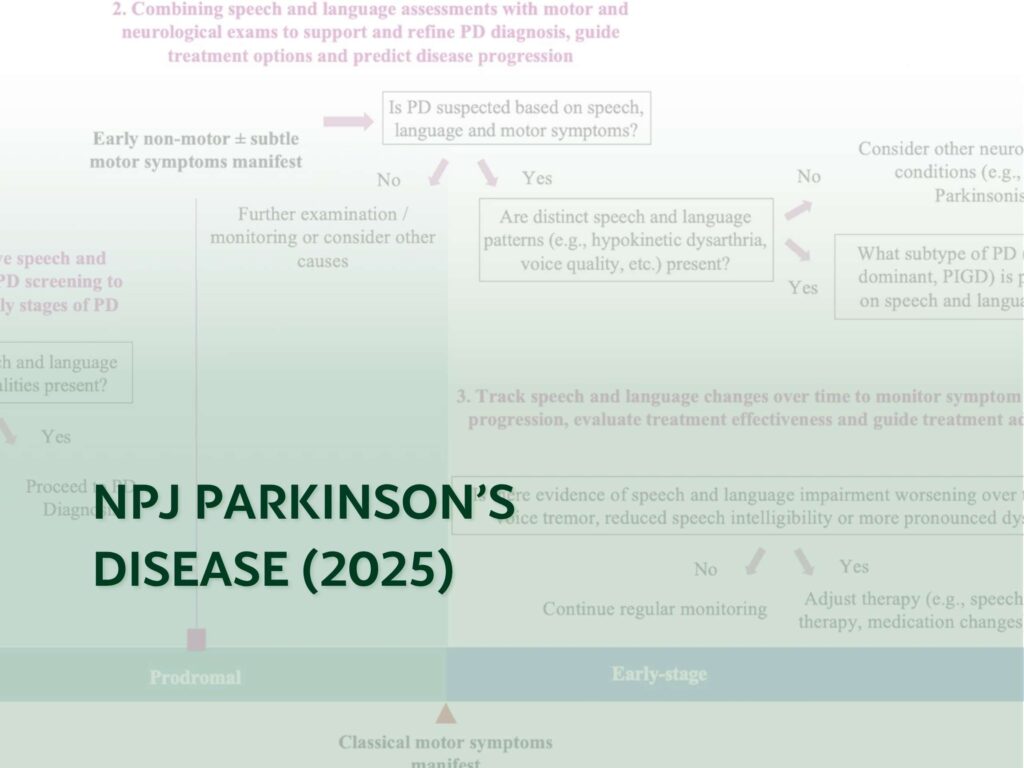
Our CEO, Prof. Adam Vogel, is a co-author on a new narrative review published in npj Parkinson’s Disease, conducted in collaboration with researchers from QIMR Berghofer Medical Research Institute, the University of Queensland, and the University of Melbourne. The review synthesises current evidence on the potential of speech and language as biomarkers for Parkinson’s disease identification and progression monitoring.
A key finding: speech and language changes can precede the defining motor symptoms of Parkinson’s by as much as a decade. Subtle shifts in pitch variability, consonant precision and pause duration may be detectable long before a clinical diagnosis is possible.
The review also highlights how consistent these markers are across languages. In a multicentre study spanning Czech, English, German, French and Italian speakers, reduced pitch variability distinguished people in the prodromal phase of Parkinson’s from healthy controls, even before motor symptoms appeared. Advanced analytical techniques, including machine learning, further strengthen the ability to detect early or prodromal Parkinson’s from simple speech tasks.
Beyond early detection, speech features evolve as the disease progresses, making them useful for ongoing monitoring and even differential diagnosis. Captured remotely via smartphone, these tools offer a scalable and cost effective path to tracking disease status across broader populations.
This review precedes our own ongoing experimental work in this space. We are currently running one of the largest speech studies in Parkinson’s disease in the world, with over 2,500 participants contributing data. It is the kind of work this review calls for, and it sits at the heart of what we do at Redenlab.