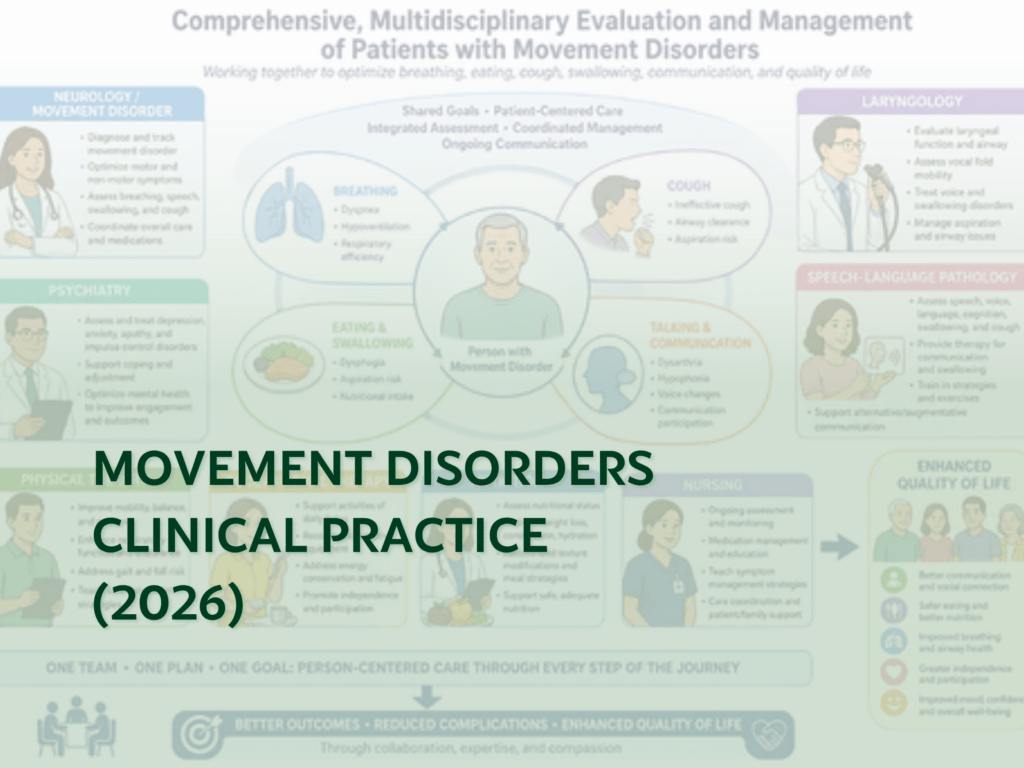
Our new review in Movement Disorders Clinical Practice looks at three functions that are fundamental to quality of life in movement disorders: breathing, eating and talking.
For speech and communication, the review highlights an important challenge. Conventional neurological assessments may not always capture the changes that matter most to how someone communicates in daily life.
The Parkinson’s disease case in the paper illustrates this clearly.
During a routine neurological assessment, the person’s speech was classified as normal. A more detailed assessment, however, identified reduced loudness, monotone speech, changes in voice quality, articulatory imprecision and reduced spontaneous intelligibility.
These were not simply differences detectable on a clinical assessment. They were already affecting communication and social participation. This raises an important question about how we measure speech in the first place.
There is another important issue: people may increase their speech effort when they know they are being assessed, particularly in a quiet consulting room with a clinician listening closely. The result is that a few minutes of speech in the clinic may look quite different from how someone communicates across days, weeks and months in their everyday environment.
This is one of the reasons we are interested in frequent, remote and objective speech measurement at Redenlab.
Rather than relying on a single snapshot, longitudinal speech data can help us understand how communication is changing over time, identify deterioration earlier and ultimately develop more sensitive endpoints for clinical trials.
There’s a bigger point here too. Speech isn’t simply another symptom to score.
For many people living with a movement disorder, being able to communicate effectively with family, friends and colleagues is fundamental to independence, participation and quality of life.
Measuring speech well means looking beyond whether someone can complete a task in a clinical setting. It means understanding how communication changes in the context of everyday life, and developing measures that can capture those changes with greater sensitivity.
Congratulations to John Dean, Lena O’Flynn, Julie Barkmeier-Kraemer and the large international team from the International Parkinson and Movement Disorder Society Voice, Speech and Swallowing Movement Disorders Study Group.